
Get More Done in Less Time with the Pomodoro Technique


As someone who works from home, I’m all too familiar with how difficult it is to focus on work-related tasks amid all the distractions, which includes, but is not limited to, social media. Before I got to know the “Pomodoro Technique,” my style of doing things was pretty infficient and inconsistent. Either I would work nonstop and get burnt out, or end up scrolling through Instagram halfway. Both of these are no good for someone who has to stay productive most of the time.
That’s when I learned about the Pomodoro Technique, and it completely changed the way I approach my workday.
What Is the Pomodoro Technique?
At its core, the Pomodoro technique is a time management system that divides your workday into 25-minute chunks, affectionately called “Pomodoros.” After each session, you’ll step away for a quick five-minute breather. Complete four cycles, and it’s time for a longer break—typically 15 to 30 minutes.
This structure is deceptively simple yet incredibly effective. It keeps you focused without running yourself into the ground. The technique was developed by Francesco Cirillo in the late 1980s, and it has since become a popular method for boosting productivity and managing time effectively.
Why It Works
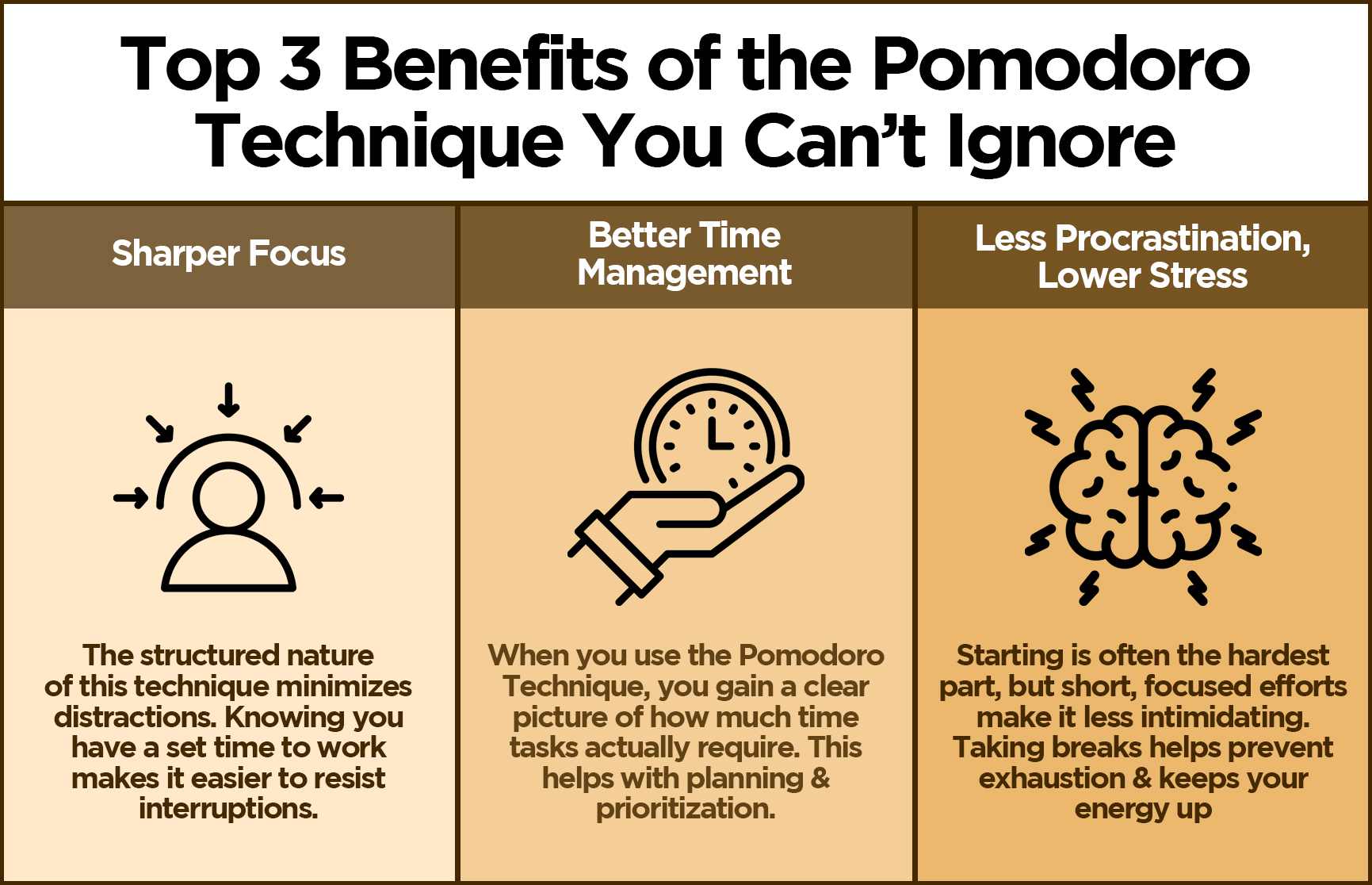
There’s something about working in short, focused bursts that just works. Twenty-five minutes is enough to get into a task without feeling overwhelmed. And the breaks really help keep you from burning out.
Justin Sung, a learning coach and doctor from New Zealand, explains it perfectly, “The Pomodoro technique works because the time pressure actually reduces attention residue.” He describes how our minds, much like a computer cache, need to clear out the remnants of a previous task before fully focusing on the next. A timer-driven approach helps wrap up one task cleanly and makes transitions smoother and focus sharper.
But that’s not all. Justin points out, “At the end of a task, our brain is primed to wrap it up cleanly, so the break helps clear lingering thoughts and prepares us for the next task.” This rhythm not only keeps distractions at bay but also creates a mental sense of urgency that sharpens focus. It’s a simple yet powerful trick that works across all kinds of tasks.
How to Get Started
Here’s a step-by-step on how to make the Pomodoro Technique work for you:
- Make a To-Do List: Write down what you need to tackle. Start with your most pressing tasks.
- Set a Timer: Grab a timer—an app, a classic kitchen timer, or even your phone.
- Focus on One Task: Work on a single item from your list for 25 minutes. Stay laser-focused.
- Take a Short Break: When the timer rings, step away. Stretch, grab a drink, or simply breathe.
- Repeat: After four Pomodoros, reward yourself with a longer break.
How to Handle Distractions
Interruptions are inevitable, but you can manage them effectively. Keep a notebook nearby to jot down unrelated thoughts that pop up. This keeps them from derailing your focus. If someone interrupts, let them know you’ll be available after the session. Turning off notifications and using noise-canceling headphones can also help.
Adapting the Pomodoro Technique to Your Needs
The 25-minute work period isn’t set in stone. Some people prefer longer intervals for deep work or shorter bursts for repetitive tasks. Experiment with different durations to find what works best for you. The key is maintaining a balance between focus and breaks.
Challenges and How to Overcome Them
Some find it difficult to stop working when the timer rings. To counter this, remind yourself that breaks improve overall productivity. Others struggle with interruptions or tasks taking longer than expected. Break larger tasks into smaller, manageable steps to fit within Pomodoros. Experiment until you find a rhythm that suits your style.
For example, let’s say you’re working on a report. If it feels overwhelming, divide it into smaller parts, like outlining, drafting one section, or revising. Addressing each step in a Pomodoro keeps the process manageable. Similarly, when interruptions occur, consider using a signal to indicate you’re in focus mode, like a sign on your desk or headphones.
Another challenge is resisting the urge to multitask. The key is to view the timer as a commitment to focus on a single task. Over time, this mindset becomes second nature. Acknowledge the process of building this habit takes time, and perfection isn’t required to see benefits.
Evidence Supporting the Pomodoro Technique
There have been several studies that shed light on how the Pomodoro Technique can make a real difference when it comes to focus and productivity. For instance, research published in the British Journal of Educational Psychology found that students who used structured breaks—like those in the Pomodoro Technique—reported improved mood and efficiency. By working in intervals with planned breaks, they not only managed their time better but actually completed tasks more quickly than when they followed their own, more spontaneous break schedules.
Another study shared on the Writineering blog, illustrates how the Pomodoro Technique helped someone cut down on study time while boosting focus. The individual noticed fewer distractions and felt more motivated to stay on track. It wasn’t about forcing longer hours in front of the desk—it was about using time more wisely.
Additionally, a study featured in the Global Educational Journal focused on nursing students and showed that the Pomodoro Technique helped them break through procrastination. With structured work sessions and breaks, these students found themselves staying on task and getting their work done more efficiently.
Decades of Combined Expertise
Best Buy Guidebook is a culmination of online publishing lessons learned. From SEO to paid ads, our team has experienced the highest of highs and the lowest of lows. Our goal now is simple: Arm readers with the most information possible.