

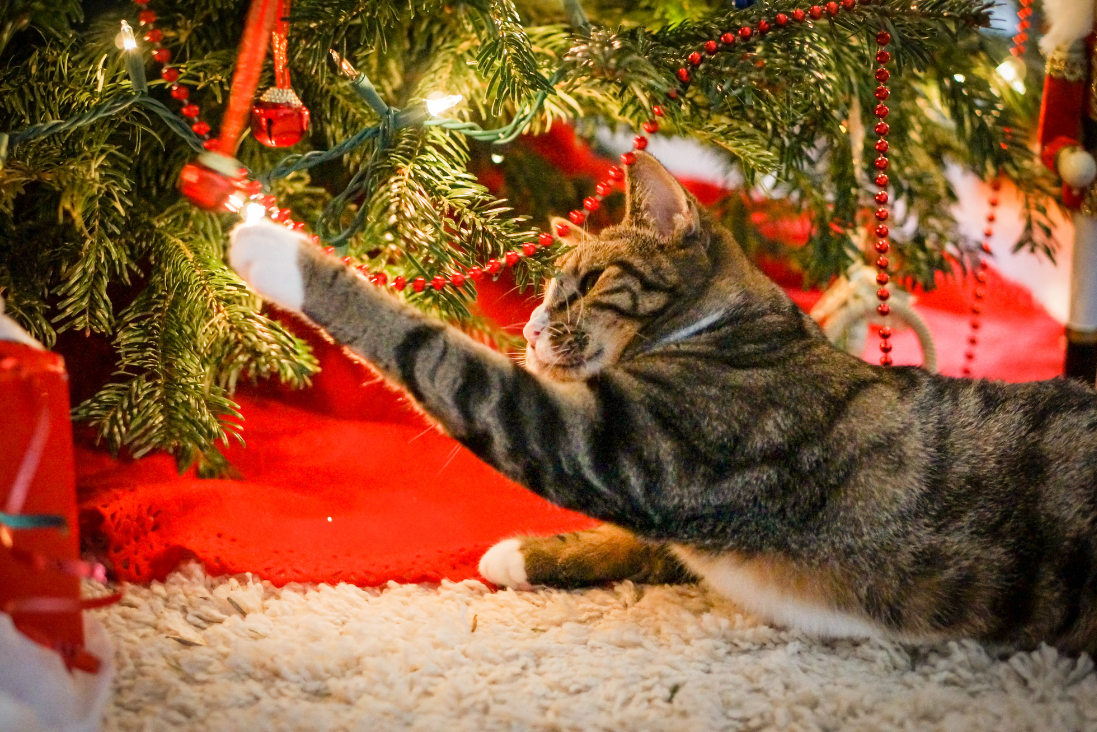
Keeping cats out of the Christmas tree isn’t just a seasonal struggle—it’s practically a rite of passage for any cat owner. The first holiday season after adopting my two furballs, Olivia and Luna, I learned this lesson the hard way. Back then, I naïvely assumed a simple “no” would deter their curiosity. Spoiler alert: it didn’t. Within minutes, the ornaments became toys, the tree skirt was a napping zone, and the tree itself? A climbing structure. If you’re a cat parent, you know exactly what I mean.
That year, I made it my mission to create a cat proof Christmas tree, and over time, I’ve gathered plenty of strategies that work. It’s not about keeping your tree perfect—it’s about keeping it safe for both your decorations and your furry mischief-makers. Here’s how I do it, step by step, with all the tricks I’ve picked up over the years.
Choose the Right Tree
It starts with the tree itself. I quickly learned that real trees, with their alluring pine scent and needle-covered branches, are just too tempting for most cats. Pine needles can be dangerous if ingested and can cause stomach upset or even blockages. These days, I stick to an artificial tree. While it’s not entirely foolproof, it eliminates one layer of danger right off the bat.
If you’re using a real tree, keep the water base covered. Cats are notorious for drinking anything they’re not supposed to, and tree water can contain preservatives or sap that are harmful. I use a simple piece of aluminum foil around the base to deter Luna, who loves to explore the bottom of the tree.
Avoid setting it up near “launch pads,” like furniture, shelves, or windowsills. Cats see these as perfect jumping-off points to dive into your tree. Trust me, I learned this after Olivia launched herself off the back of the couch and landed square in the middle of the tree, sending ornaments flying everywhere.
Instead, place the tree in a corner if you can. This reduces the angles from which they can attack. I also use fishing line to secure the tree to the wall. Tying it around the trunk near the top and attaching it to a sturdy hook keeps the tree upright even if Olivia or Luna get too ambitious.
What To Do About the Ornaments…
When it comes to ornaments, think like a cat. Anything shiny, dangling, or breakable is essentially a flashing “play with me” sign. I reserve the bottom third of the tree for non-breakable, non-dangly ornaments—like felt or wooden decorations. I’ve found that tying ornaments directly to the branches with floral wire makes them harder for cats to bat off. The top half is where I place anything delicate or sentimental.
A tip I swear by: Avoid hooks. They’re too easy for cats to knock loose. Instead, use ribbon or wire to secure ornaments tightly. This small change has saved me from countless shattered bulbs.
Tinsel is a no-go in my house. While it might look festive, it’s dangerous for cats. If ingested, it can cause serious health issues, including intestinal blockages that require surgery. Glittery garlands, while less risky, are still tempting, so I keep decorations simple and skip anything stringy.
…And the Christmas Lights
Christmas lights are one of the trickiest parts of having a cat proof Christmas tree. Cats love to chew cords, which can lead to electrical shocks or worse. To combat this, I use cord protectors—simple plastic tubing that covers the exposed wires. It’s cheap, easy to find, and gives me peace of mind. I also tape cords to the wall where possible to minimize loose, dangling wires.
If you have a cord chewer like Olivia, consider treating the cords with a bitter deterrent spray. It’s safe and doesn’t harm the decorations but makes the cords far less appealing. You can also look into pre-lit trees since the wires are lot more secure on them.
Keep the Base Safe
Cats are curious about anything new, and the tree base is no exception. To make it less appealing, I scatter pinecones around the bottom. Cats hate walking on prickly surfaces, and the pinecones double as a natural, festive decoration. If pinecones aren’t your thing, aluminum foil works too—it’s crinkly and unpleasant for cats to touch.
For real trees, covering the water basin is crucial. I use a tree skirt with a secure lining underneath to keep Luna from sneaking a drink.
Deter Cats with Smells
One of the best tricks I’ve found is using scents cats dislike. Citrus works wonders. I keep orange and lemon peels in small mesh bags at the base of the tree. You can also make a DIY spray with water and a few drops of citrus essential oil. Lightly spritz the tree and surrounding area—but be sure not to oversaturate or spray near electrical components.
Another great option is bitter apple spray. While marketed for dogs, it works well for cats too. A quick spray on the lower branches helps discourage nibbling and batting. Luna especially hates the taste, so it’s become my go-to for keeping her at bay.
Create a Distraction
Sometimes, the best defense is a good offense. I set up a separate “cat tree” in the same room as the Christmas tree. This isn’t an actual tree but a small area with cat toys, scratching posts, and some hanging decorations that are safe for them to play with. The idea is to give them their own version of the tree so they leave mine alone. It doesn’t always work 100%, but it helps redirect their energy.
Despite all these precautions, I’ve learned that vigilance is key. During the first week or so after setting up the tree, I keep a close watch to see how Olivia and Luna react. If they seem overly interested, I adjust my strategies. Sometimes, it’s a matter of adding another deterrent or rearranging the room to remove potential jumping points.
At the end of the day, having a cat proof Christmas tree isn’t just about protecting ornaments—it’s about creating a safe environment for your cats. The holidays are stressful enough without worrying about your pets getting hurt or destroying cherished decorations. Over the years, these strategies have made Christmas more enjoyable for everyone in my home, cats included.