
Common Mistakes to Avoid When Installing a Security System in Your Home

Installing a security system is one of the smartest decisions you can make to protect your home or business. But even the fanciest system won’t do much good if it’s set up poorly. In fact, inaccurate placement can seriously get you in trouble by inviting a lawsuit, especially if your system has the potential to invade your neighbor’s privacy. Let’s break down some common mistakes people make during home security system installation and how you can avoid them.
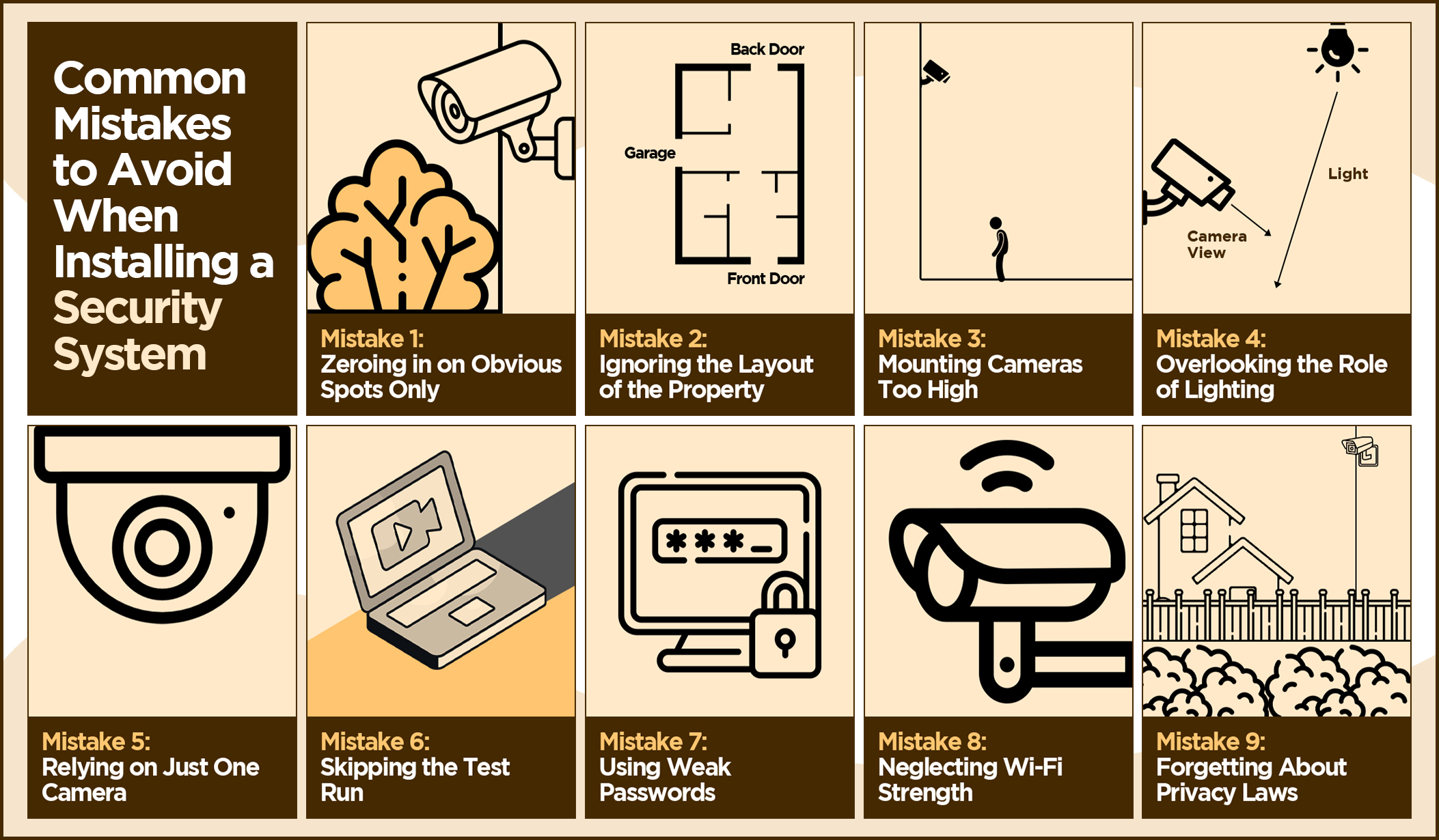
Mistake 1: Zeroing in on Obvious Spots Only
Sure, the front door and big windows scream “Secure me!” but don’t stop there. Burglars aren’t as predictable as you’d expect—they’re not always climbing through the living room window. The side gates, basement windows, or even that tiny bathroom window you assume nobody could squeeze through can provide a nice inlet for burglars to break in.
Mistake 2: Ignoring the Layout of the Property
Before you set up a security system, take a stroll across your property. One of the biggest mistakes I see when people install security systems is completely overlooking the layout of their property.
It’s easy to think that putting up a few cameras here and there will do the job. But if you don’t take the time to plan out exactly where those cameras should go, you’re asking for trouble. if you’ve mapped out your property’s layout, you can make sure that every vulnerable area is covered. It also helps to identify potential trouble spots that could be easily overlooked.
Mistake 3: Mounting Cameras Too High
Another big mistake that you’re likely to make with your security system is mounting cameras too high. It’s understandable that you want to keep them out of reach so no one can mess with them. But here’s the problem: if you mount your cameras too high, you’re either likely to sacrifice the quality of the footage or end up getting a great view of the top of someone’s head!
The sweet spot for camera placement is typically around 8 to 10 feet high. This is enough to keep it out of easy reach but low enough to capture detailed footage. If someone walks by, you’ll get a clear shot of their face. Plus, at that height, you’re less likely to get weird angles that make it hard to identify things.
Mistake 4: Overlooking the Role of Lighting
Cameras and darkness don’t mix well, no matter how advanced your camera’s night vision is. Modern security cameras do come with infrared capabilities that let them see in low-light conditions, but darkness can still make it hard to capture clear, usable footage. If your property is poorly lit, you’re basically leaving an open invitation for intruders to roam undetected.
A simple and effective solution is installing motion-sensor lights in those dark corners and shadowy spots around your property. Motion-activated lights don’t just illuminate your yard; they also give your cameras a “flashlight” to work with.
But there’s another bonus here: those bright lights can also act as a deterrent. Most criminals are looking for easy targets. If they see a well-lit area with cameras actively recording, they’re much more likely to back off. Nobody likes being caught in the spotlight, especially when they’re up to no good.
Mistake 5: Relying on Just One Camera
If you have decided to guard your property against thieves and intruders, you simply cannot rely on just one camera. Having a single camera at your service provides the intruders with a whole set of possibilities: they can disable it, or with a change in its direction, they can find time to break in.
You can avoid this kind of situation by strategically placing multiple cameras throughout your property. A good security system should cover key areas like all entry points (front and back doors, windows), pathways, driveways, and any blind spots you may have missed. By placing cameras in these different zones, you create a network of coverage to monitor your home from multiple angles.
Mistake 6: Skipping the Test Run
One of the most overlooked steps in setting up a security system is ignoring the test run. It’s easy to think that once the system is installed, everything is good to go, but in reality, a test run is equally important to make sure everything works as it should.
After installation, you should always take the time to walk through your property and check each camera’s angle, coverage, and video quality. It’s a simple step that can save you from future headaches. Imagine the frustration of realizing that your camera is pointed at a tree instead of your front door. Or that it’s capturing blurry footage because of improper focus or poor lighting.
Mistake 7: Using Weak Passwords
Many of us don’t bother securing our security systems with strong passwords, thinking it’s “unimportant.” Many people even stick with default passwords, which are easy to guess. It’s tempting to choose something simple and easy to remember, but that’s exactly what makes it easier for hackers to break into your system.
To properly secure your system, what’s actually needed are strong, unique passwords that combine letters, numbers, and special characters. A good rule of thumb is to aim for at least 12 characters, mixing upper and lower case letters, numbers, and symbols. The more complex and unique your password, the harder it will be for anyone to break in.
Mistake 9: Neglecting Wi-Fi Strength
If your security system relies on Wi-Fi, you absolutely cannot risk having a weak signal. Many people assume that once their cameras are installed and powered on, everything will work smoothly. However, if the Wi-Fi signal in your home is weak or unstable, your cameras may not work as intended, leading to poor video quality, dropped connections, or, in some cases, total failure to transmit footage.
To avoid this issue, ensure that your router is placed in a central, open area of the house, free from physical obstructions like thick walls or large furniture. Wi-Fi extenders or mesh networks can be useful to improve the signal strength in areas where it may be lacking. If your security system allows it, consider placing cameras closer to your router or using Ethernet cables for more reliable connections, especially for high-resolution cameras that require greater bandwidth.
Mistake 10: Forgetting About Privacy Laws
Here’s the thing: Pointing your camera directly at the neighbor’s backyard isn’t just rude—it can also lead to potential legal issues. Nobody wants to feel like they’re being watched, and you certainly don’t want to give off that impression. Keep your cameras focused on your property to avoid any misunderstandings or unwanted attention from neighbors or local authorities.
It’s also a good idea to check local regulations regarding surveillance. Some areas have strict laws about the angles at which cameras can be pointed or how much of someone else’s property can be captured. This can be especially important in urban settings where properties are close together.
Decades of Combined Expertise
Best Buy Guidebook is a culmination of online publishing lessons learned. From SEO to paid ads, our team has experienced the highest of highs and the lowest of lows. Our goal now is simple: Arm readers with the most information possible.