
logo
logo
  • Homepage
  • Home Improvement
  • Patio and Garden
  • Family and Lifestyle
  • Home Tech
  • Office
  • Best Buy Guidebook
  • Home Technology

What Air Purifiers Do (And What They Don’t)

Connor Manion
Written By Connor Manion
Original Publish Date: Jul 9, 2024, 08:55 PM
Last updated: Sep 30, 2024, 06:45 PM
Disclosure ↓
air purifiers
View all Contents
  • What is an Air Purifier?
  • How Does an Air Purifier Work?
  • Debunking Myths About Air Purifiers
    • Myth 1: Air Purifiers Eliminate All Allergens
    • Myth 2: Air Conditioners Are a Substitute for Air Purifiers
    • Myth 3: Air Purifiers Only Work in Small Rooms
    • Myth 4: If You Live in a Clean Environment, You Don’t Need an Air Purifier
    • Myth 5: All Air Purifiers Are the Same

Air purifiers are one of those gadgets that have steadily made their way into our homes, largely because we’re all a bit more aware of what’s in the air we breathe these days. From city smog to the unseen particles floating around our living rooms, there’s plenty we’d rather not inhale. So, let’s dive into what an air purifier really is and how it actually works to clear up our air.

What is an Air Purifier?

Simply put, an air purifier is a device designed to remove impurities from the air in a room. These impurities can include things like dust, pollen, pet dander, and smoke particles. If you’re thinking this sounds a bit like a sci-fi gadget, you’re not entirely off the mark. In many ways, air purifiers are like domestic heroes, fighting unseen enemies to keep the indoor environment clean and breathable.

The main goal of using an air purifier is to create a cleaner, healthier air environment. People who suffer from allergies, asthma, or other respiratory conditions often find air purifiers helpful. The devices work to significantly reduce or eliminate harmful particles and allergens from the air, making it easier to breathe, which can be a big relief in seasons when pollen and other irritants are in full swing.

How Does an Air Purifier Work?

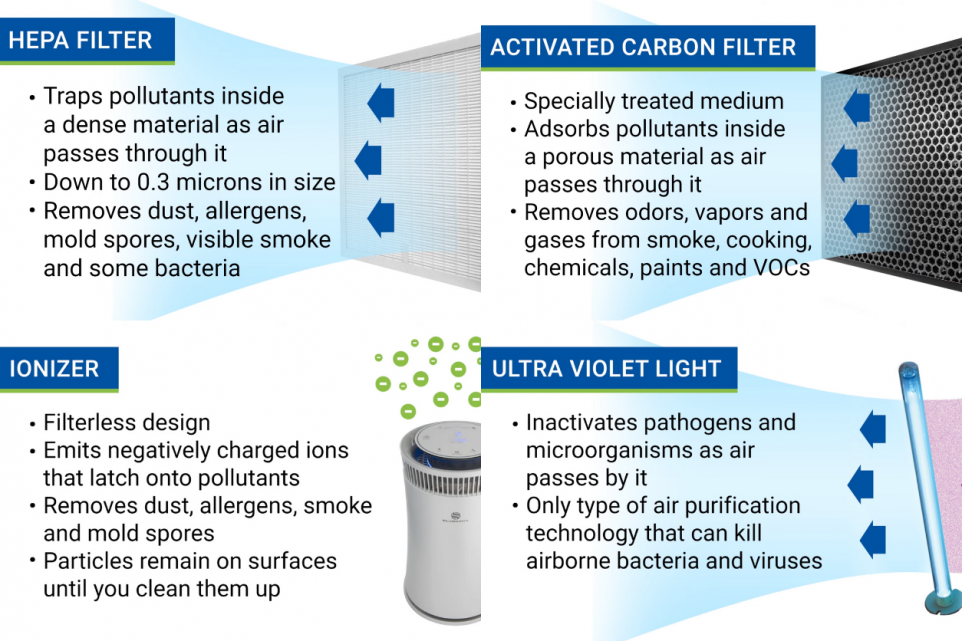
The magic of air purifiers lies in their ability to pull in polluted air, filter out the bad particles, and then circulate clean air back into the room. They’re designed to be used continuously without much intervention besides the occasional maintenance. Let’s explore the sequence and types of filters involved in most modern air purifiers.
different types of filters
Image credit: Home Air Guides

1. Air Intake and Pre-Filter: The process begins when air is drawn into the air purifier by a fan. Most units are designed with a basic cover that can be easily removed to access the internal filters. The first line of defense against larger particles like hair, dust, and lint is the pre-filter. In many models, the pre-filter is washable or vacuumable, making maintenance fairly straightforward. Regular cleaning of the pre-filter, generally recommended monthly, helps maintain the efficiency of subsequent filters and extends their lifespan.

2. Carbon Filter: Following the pre-filter, the air usually passes through a carbon filter. This filter is crucial for tackling volatile organic compounds (VOCs) and odors in your environment. Made from activated carbon, it’s porous and adsorbs gases and odors from the air. Although carbon filters are less effective against larger particulates, they are integral for reducing smells and chemical vapors, making them essential for maintaining a fresher indoor atmosphere.

3. HEPA Filter: The core of most air purifier systems is the HEPA filter. This component is critical due to its ability to trap 99.97% of particles that are 0.3 microns in diameter or larger. The effectiveness of HEPA filters comes from their dense, pleated design, where the mat of fibers captures fine particulates, including pollen, mold spores, and, most importantly, much finer dust particles. This filtration stage is where the most significant reduction of airborne pollutants occurs.

4. Direction of Air Flow: Once the air has been cleaned, it is pushed back into the room. The design of the air purifier dictates the direction of this clean air; some models release air vertically, while others might direct it sideways. The direction of airflow does not generally impact the purifier’s effectiveness but can influence where you might choose to place the unit in your room for optimal air circulation.

5. Continuous Operation: For an air purifier to be effective, it often needs to run continuously. This constant operation ensures that air in your room is repeatedly cycled through the purifier, allowing for continuous filtration and maintenance of clean air standards within your living or working space.
Debunking Myths About Air Purifiers

There’s a lot of misinformation floating around about air purifiers. It’s crucial to get the facts straight, especially if you’re considering one as a solution to improve indoor air quality. Let’s clear up some common myths:

Myth 1: Air Purifiers Eliminate All Allergens

First up, many believe that once you plug in an air purifier, all your allergy troubles vanish. While it’s true that air purifiers can significantly reduce the presence of airborne allergens like dust, pollen, and pet dander, they don’t completely eliminate them. These devices are excellent at filtering out many particles that can cause allergic reactions, but they can’t remove allergens embedded in furniture or carpets unless these particles are airborne and pulled through the purifier’s filters. According to the American Academy of Allergy, Asthma, and Immunology (AAAAI), you should be taking other precautions, like removing allergens and properly ventilating living spaces in your house.

Myth 2: Air Conditioners Are a Substitute for Air Purifiers

Another common misconception is that air conditioners perform the same function as air purifiers. Although some modern air conditioners feature built-in filters that can trap larger particles, they’re not designed to purify the air at the same level as a dedicated air purifier. Air conditioners primarily regulate temperature and aren’t equipped to filter out microscopic allergens or pollutants like VOCs (Volatile Organic Compounds) effectively.

The ionization filters in air conditioners act very differently than HEPA filters. While they do catch dust, ionization filters don’t have any effect on mold spores and other fine particles in the air that can cause allergies. If anything, the ionization caused by an AC filter can create small amounts of ozone, which can be bad for people suffering from asthma or other respiratory conditions.

Myth 3: Air Purifiers Only Work in Small Rooms

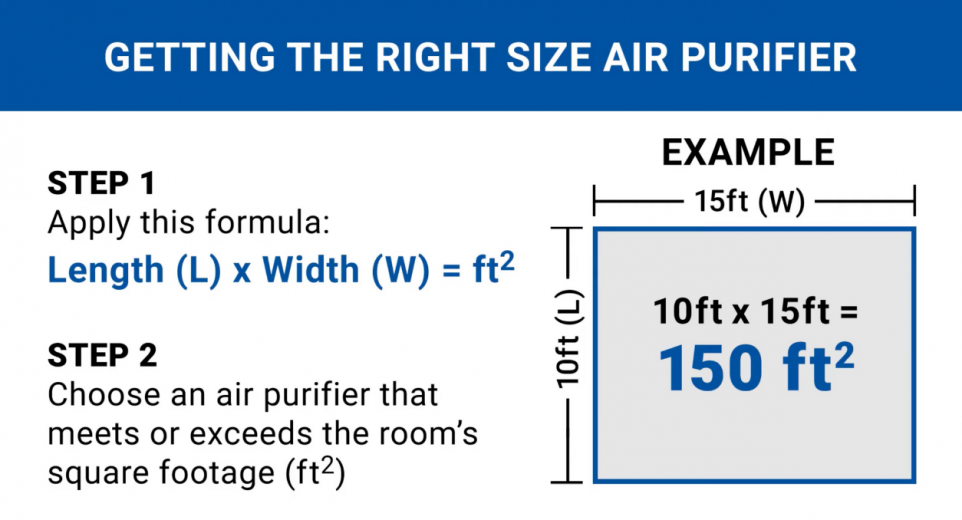
People often think that air purifiers are only effective in small or confined spaces. However, the reality is quite different. Modern air purifiers are designed to accommodate various room sizes, and many models are effective in large spaces as well. The key is to choose a purifier with a Clean Air Delivery Rate (CADR) suitable for the room where you plan to use it. CADR is a measure of how much filtered air an air purifier returns to the room, expressed in cubic feet per minute (CFM). This measurement indicates the effectiveness of the purifier against smoke, pollen, and dust—the three most common pollutants.

air purifier size guide
Image credit: Home Air Guides

The CADR rating helps you understand how well a purifier can clean the air in a specific-sized room. Essentially, a higher CADR rating indicates a greater ability to clean a larger volume of air efficiently. Therefore, an air purifier with a high CADR rating is capable of servicing larger spaces effectively. For example, if a purifier has a CADR of 200 for smoke, it can effectively clean and maintain a room of about 200 square feet. It’s important to note that these calculations typically assume a standard room height of 8 feet. If your room has higher ceilings, you’ll need a purifier with a higher CADR to compensate for the increased volume of air.

Myth 4: If You Live in a Clean Environment, You Don’t Need an Air Purifier

Even if you live in an area perceived as ‘clean’ or less polluted, indoor air can still be laden with invisible pollutants like radon, indoor pesticides, or gases from new furniture. Furthermore, the outside air quality does not always reflect indoor conditions, as homes can trap outdoor pollutants and introduce new ones from indoor sources. Thus, an air purifier can be beneficial even in cleaner environments.

Myth 5: All Air Purifiers Are the Same

Not all air purifiers are created equal. The efficiency of an air purifier in cleaning the air depends on several factors, including its filter type, size, and technology used. For instance, HEPA filters are excellent for particulate matter, while activated carbon filters are better for odors and gases.

One key issue is leakage. Despite having a HEPA filter, many air purifiers do not have airtight housings. This allows unfiltered, dirty air to bypass the HEPA filter through small gaps around the filter frame or between the frame and the purifier housing. As a result, while the filter itself might technically stop nearly all particles that pass directly through it, the overall effectiveness of the air purifier can be significantly reduced, sometimes to as low as 80% or less in terms of actual air cleaning capacity.

It’s crucial to understand that HEPA filters are primarily effective against particulate pollutants like dust, mold, pollen, and some bacteria. They do not, however, capture gases, odors, or volatile organic compounds (VOCs). For these types of pollutants, activated carbon filters are used. These filters work by adsorption, where gas molecules chemically bond to the surface of activated carbon. The activated carbon is highly porous, giving it a vast surface area that can trap gas molecules and odors effectively.

Decades of Combined Expertise

Best Buy Guidebook is a culmination of online publishing lessons learned. From SEO to paid ads, our team has experienced the highest of highs and the lowest of lows. Our goal now is simple: Arm readers with the most information possible.

Contributors

Connor Manion
Connor Manion
Climate Control Home Appliances
Related Reads
  • Air Purifier vs Humidifier: Which Is Right for Your Space?
  • Myth or Fact: Do Air Purifiers Help With Smell?
Back to top
logo

©2026. All Rights Reserved

  • About Us
  • FAQ
  • Contact Us
  • Privacy
  • Terms
Contact

hello@bestbuyguidebook.com

We independently research, test, review, and recommend the best products. If you buy something through our links, we may earn a commission at no cost to you. Click here to learn more about our process.